Venues
The Table Upstairs: How the Comedy Cellar Became Comedy’s Clubhouse
A basement under a Middle Eastern café, a hostess turned booker, and one reserved table turned a struggling room into the most coveted stage in stand-up.
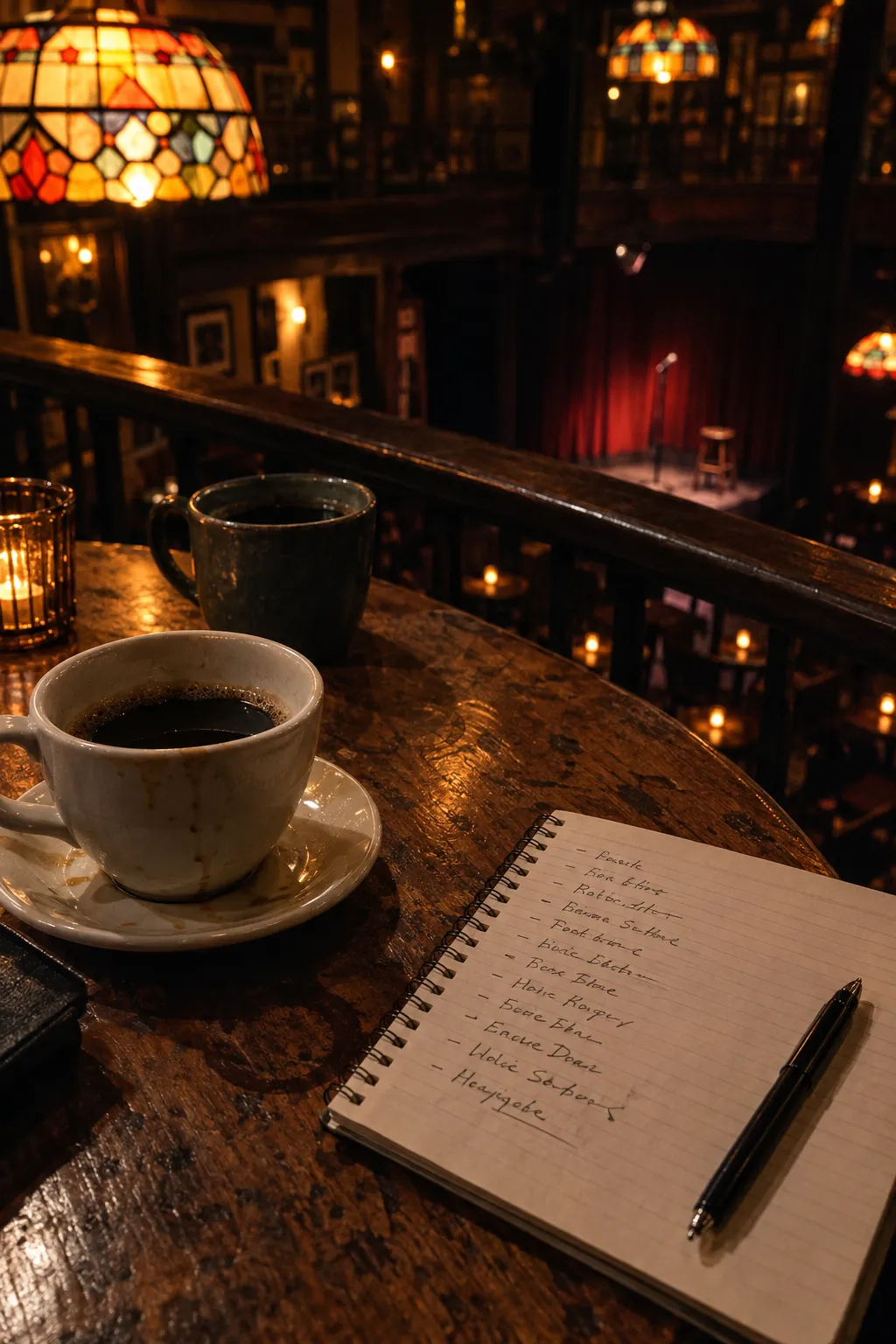
The Comedy Cellar did not start as a comedy club. It started as a basement problem. Manny Dworman, a former cab driver who had built a small Greenwich Village nightlife business, opened the Olive Tree Cafe in 1969 and found himself with an empty room underneath it. He tried several ideas there, including a piano bar, before comedian Bill Grundfest walked in around 1981 and pitched stand-up (Paste, Village Preservation).
Among the first comics through the door were Jon Stewart, Gilbert Gottfried and Bill Maher (Village Preservation). Stewart was living on Grand Street and working at a nearby restaurant, going on late in the lineup for little money (New York Magazine).
A hostess becomes the gatekeeper
Grundfest left about two years in to write for television. Dworman replaced him with Estee Adoram, a hostess at the restaurant whose husband played accordion in Dworman’s band. Over the next four decades she built one of the most exclusive booking processes in the business (Paste).
Her method is simple to describe and hard to pass. A comic usually needs a recommendation from someone she already trusts, then gets five minutes. She watches for confidence and for how a comic handles a joke that dies. She says she doesn’t formally “pass” comics the way other clubs do. If she sees something, she gives a few spots and follows up (The Black Hoody).
“She doesn’t own the club, but it might as well be hers.”Ray Romano, via Vanity Fair
A room where you were allowed to fail
Comics describe the Cellar as the opposite of the uptown clubs, where you had to be on your A game every time. Downtown, comedians had leeway to try jokes that might not work, and the club didn’t censor acts (New York Post).
That freedom was tested in the mid-1990s, when the stand-up boom collapsed and landmark clubs like Catch a Rising Star went under. One night, comic Gregg Rogell skipped his set and simply chatted for 20 minutes with the only person in the audience, a Dutch tourist (New York Post). Louis C.K. later credited Manny Dworman with keeping comedy alive by keeping the stage running even when it was empty (Wikipedia).
The table
The Cellar’s secret weapon was furniture. A table in the Olive Tree upstairs became a green room, a debate floor and a gossip exchange for working comics. Accounts differ on who started it: one history credits Dworman, another says Nick DiPaolo asked for it (Paste, New York Post). Either way, it turned the club into a clubhouse. Chris Rock and Jerry Seinfeld started dropping by, and the table later inspired Colin Quinn’s Comedy Central show Tough Crowd (Entrepreneur).
From slump to sensation
The comeback came in waves. First, regulars like Jim Norton and Bill Burr plugged the club on Opie & Anthony. Then Seinfeld’s 2002 documentary Comedian put it on screen. In 2010, FX’s Louie opened with it every week (New York Post). Before the pandemic, the club was turning away about 1,000 people on an average Saturday.
The show itself is built differently, too. Instead of the usual emcee, middle act and headliner, the Cellar runs about five headliner-level comics doing their best 15–20 minutes (The Comic’s Comic). That format, plus surprise drop-ins, is why a regular weeknight can feel like an event.
The open question is succession. Owner Noam Dworman has worried aloud that the club’s own success could squeeze out newcomers: “there won’t be space for newcomers” (Vanity Fair). Forty-five years in, the Cellar is still balancing being a tourist landmark with being a place where unknowns get their shot.
Keep reading
Thrown Out, Then Signed: How the Comic Strip Turned Eddie Murphy and Chris Rock Into Stars
A Bronx bingo-hall operator, a Harvard lawyer and a room on Second Avenue built the Upper East Side’s star factory, then managed the biggest comic of the 1980s.
From the List to the Lineup: A Field Guide to New York’s Open Mic Economy
Five-dollar mics, barking for stage time, and bringer shows: the unglamorous ladder every New York comic climbs, and which rungs are worth it.
Before the Clubs: The Greenwich Village Coffeehouses That Invented Modern Stand-Up
Long before two-drink minimums, comics like Lenny Bruce, Joan Rivers, Woody Allen and Richard Pryor worked out a new kind of comedy between folk sets on MacDougal and Bleecker.